Net Play & Smash

Pro Padel Finishing Shots: Patterns Across 5,500 Points

A study of 5,513 World Padel Tour points uncovers striking differences in how men and women finish rallies.

Reading as PlayerOne story · two ways to read it
▲ Player edition — what to try on court

To consistently win more points, you need to understand that how you finish changes depending on the rally's length, and men's and women's professional players show different patterns in these crucial moments. Specifically, the data shows that professional men are able to hit more winners and make fewer errors in their finishing actions compared to professional women. This isn't about strength; it's about tactical choices and shot execution under pressure. Knowing this helps you tailor your game. For both men and women, the smash is the go-to winning shot, especially after the ball has bounced off the back wall for women on their forehand side. However, beware of unforced errors, as many pro players falter on back wall shots or when hitting flat forehands and backhands without using the glass.

Another key insight is how effectiveness changes throughout a point. The pros, both men and women, are more prone to errors and less likely to hit winners in the very first five shots of a rally. Think about it: the point is fresh, positions aren't fully established, and mistakes happen. But as the point gets longer, players settle in, work the ball, and their finishing effectiveness actually improves. This means early point aggression without precision can backfire, while patient construction can set up clearer opportunities. Finally, there's a fascinating difference in the forehand volley: professional men tend to make more errors with it, while professional women use it to hit more winners. This highlights how specific shots can be deployed differently across various playing styles and genders, offering a clear area for you to refine your own approach based on your game. Understanding these nuances allows you to play smarter, making better decisions about when to attack, when to defend, and which shots to trust.
By the numbers
5513Points analyzed
5Tournaments analyzed
6.7Men errors (CSR) first 5 shots
5.5Women errors (CSR) first 5 shots
-6.7Men winners (CSR) first 5 shots
-5.5Women winners (CSR) first 5 shots
<0.001Gender winner/error difference (p-value)

On court: try this

  1. Prioritise the Smash: When you get a lob that sits up, don't just put it back in play. Focus on hitting a smash with intent.
> Coach's Tip: "Aim to hit the ball high and into the corner, or for a clean winner out of the court. Don't just hit it hard; direct it with purpose." If you're a woman player, especially pay attention to the forehand off the wall smash. When the ball comes off the back glass on your forehand side, attack it with your smash. The goal is to either win the point outright or force a weak reply.
  1. Smart Volley Selection: If you're a man and find your forehand volley often results in an error, try to use it more for placement and less for power. Focus on controlling the ball, pushing it into open space or towards your opponent's feet, rather than trying for a sharp angle or outright winner every time.
> Coach's Tip: "Think about setting up the next shot rather than finishing with this one. A solid forehand volley into the corner can often be more effective than a rushed, powerful one down the middle."
  1. Extend Early Points: Knowing that errors are more common in the first five shots, avoid high-risk, low-percentage shots early in the rally. Focus on consistency, keeping the ball deep, and building the point. If you're hitting your fifth shot and the opportunity hasn't clearly presented itself, resist the urge to go for broke. Instead, hit a solid globito (a deep lob) or a controlled bandeja (an attacking slice shot from mid-court) to reset the point and wait for a clearer opening.

Drills to practise

  1. Smash Repetition from the Back Wall:
* Set up: Partner feeds lobs that bounce off the back wall on your forehand side (or backhand if you're working that shot). Stand in your normal attacking position at the net. * Focus: Work on your footwork to get behind the ball, setting up for a forehand off the wall smash. Emphasise a full swing and hitting the ball at its highest point. Aim for consistency and power. * Improvement: Count how many smashes you can hit cleanly out of the court or against the back wall, forcing a weak return, out of 10. Aim for 7-8 successful attempts.
  1. Controlled Forehand Volley Placement:
* Set up: Stand at the net. Partner feeds medium-paced balls directly to your forehand side. Place a target (e.g., a cone or spare ball) in the deep corner on the opposite side. * Focus: Practice hitting your forehand volley with precision, aiming for the target. Concentrate on a firm wrist, compact swing, and stepping into the shot. Avoid trying to hit it too hard; prioritising placement over raw power. * Improvement: Track how many times you hit the target out of 20 volleys. Increase the target distance or reduce its size as you improve.
  1. Point Extension (First 5 Shots):
* Set up: Play points starting from a serve, but with a rule: neither player can go for a winner until at least 5 shots have been played (i.e., the 6th shot is the first one where you can try to finish). * Focus: This drill forces you to play defensively and consistently through the early phase of the point. Focus on deep lobs, controlled bandejas, and hitting to your opponents' feet to avoid errors. * Improvement: Count how many times you can successfully pass the 5-shot mark without an unforced error. Also, notice if you feel more comfortable going for the winner on the 6th shot or later, as opportunities become clearer.

Common mistakes

* Going for a winner too early: Many players rush to finish the point in the first few shots, leading to unforced errors.
* Quick fix: Consciously tell yourself, "Just get the ball over and deep" for the first 3-5 shots. Focus on consistency and making your opponents work.
* Hitting back wall shots without purpose: Simply hitting the ball off the back wall often gives your opponents an easy setup.
Quick fix: When the ball comes off the back wall, think about where* you want it to go. Can you hit an attacking lob, or a deep contrapared (a shot hit off your back wall to your opponent's side wall) to buy time? Avoid just pushing it back into the middle.
* Flat forehands/backhands without the wall as an error: Trying to hit flat, hard shots from the back of the court without the benefit of the side walls can be very risky.
* Quick fix: If you're hitting from the back of the court and the ball isn't coming off the glass, consider a bandeja or vibora (another attacking slice overhead) to keep the ball low after the bounce, or a deep lob to reset. Only go for flat power if you have a clear opening and are in a strong court position.
* Men over-attacking with the forehand volley: Trying to put away every forehand volley with too much power.
* Quick fix: For your forehand volley, focus on control and placement. Think about creating angles or hitting to the opponent's feet. Power comes second to precision.

Take it to your next match

Next time you step on court, make a conscious effort to extend the first five shots of every point. Don't go for glory too early; instead, build the point patiently and wait for a clear opening. When that opportunity does come, especially if it's an overhead ball, trust your smash. For men, think about placing your forehand volleys more, and for women, really lean into that forehand off the wall smash as a winning weapon. You've got this!

◆ Coach edition — how to teach it

This study looked at over 5,500 points from five World Padel Tour tournaments and asked a straightforward question: how do professional players actually finish points, and does that differ between men and women? The answers are clear enough to change what you prioritise in training.

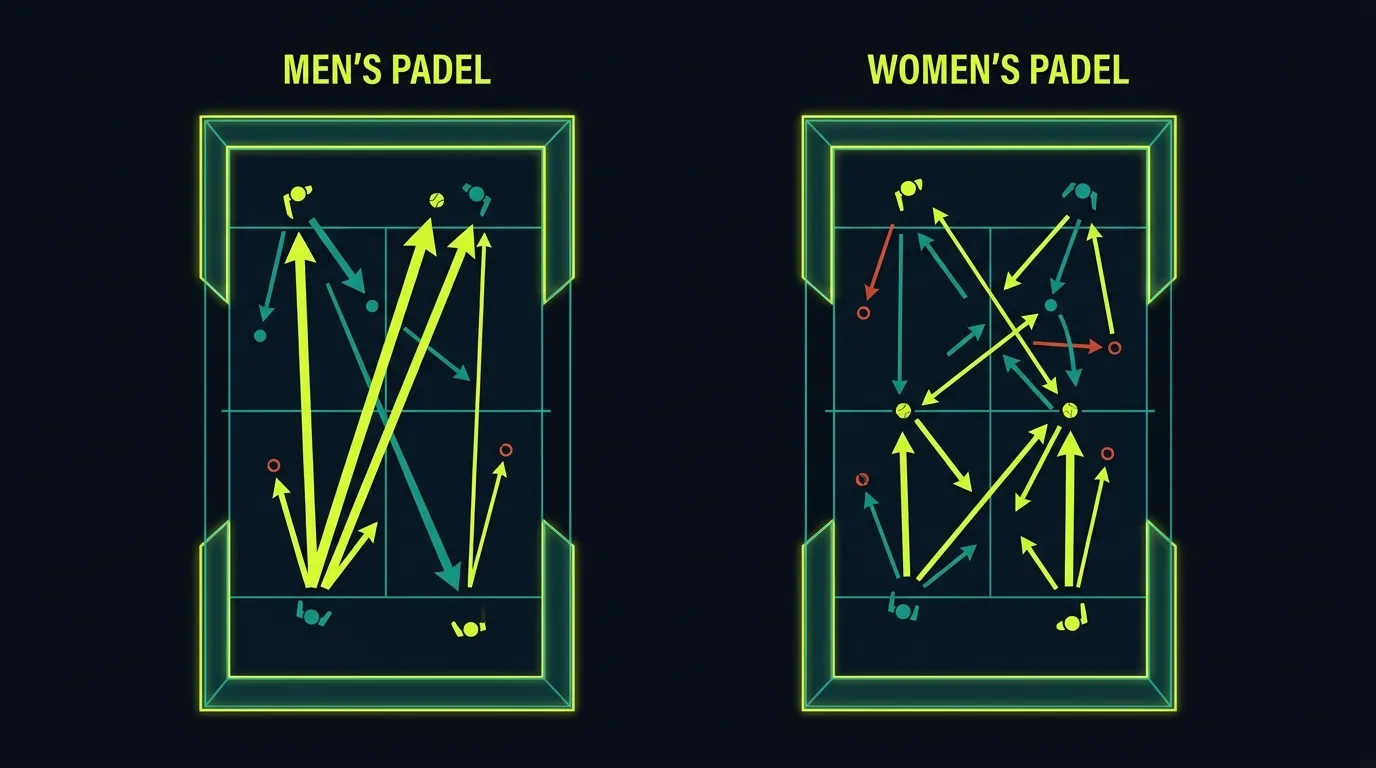
The big picture is that men finish more effectively. They convert more attacking opportunities into clean winners and commit fewer errors when they go for the kill. Women's professional play ends more often in errors rather than outright winners. This is not a comment on the quality of the women's game — it reflects a style difference that runs through the whole point, not just the last shot. Points in the women's game tend to be longer, with more back-court exchanges, more lobs, and more glass play. The finishing moment arrives later and under different circumstances.

What that means for you as a coach: if you coach men, you are training players who will attempt to end points aggressively and often from the net. Your job is to make sure those attempts are technically clean and tactically well-chosen. If you coach women, you are preparing players for a longer battle where the finishing opportunity must be earned across more shots — and where converting it cleanly when it comes matters just as much.

The smash is the primary finishing weapon in both categories — no surprise there. What is worth noting is the forehand smash off the back wall, the shot that follows a lob dropping into the back court and rebounding off the glass. In women's professional padel this shot shows up as a notable winner. It means your female players need to be technically sound in reading a deep lob, getting behind it, and attacking off the rebound — not just surviving the back-wall exchange with a defensive reply.

On errors: the most frequent finishing mistakes in both groups came from back-wall shots and from direct forehand or backhand groundstrokes hit without any wall involvement. When players try to end the point from deep without using the glass, they miss. That is tactically important — finishing from the back court is high-risk, and players who attack from there rather than working back to the net are gambling.

There is also a meaningful gender split in the forehand volley. Male professionals make more errors with it; female professionals hit more winners with it. That distinction should directly shape how you allocate technical time with each group.

Finally, both groups share a clear pattern: the first five shots of any point are where errors cluster and winners dry up. As the point extends, both men and women become more effective. This is consistent with what we know about professional padel — early in the point nobody has control; control is built, then seized.


By the numbers
5513Points analyzed
5Tournaments analyzed
6.7Men errors (CSR) first 5 shots
5.5Women errors (CSR) first 5 shots
-6.7Men winners (CSR) first 5 shots
-5.5Women winners (CSR) first 5 shots
<0.001Gender winner/error difference (p-value)

Coaching cues & teaching points

    1. "Behind the ball, not beside it" — for back-wall smashes, players must track the lob early and position themselves behind the ball's bounce line before it reaches the glass, not scramble after it.
    2. "Contact above your shoulder" — smash winners come from height; dropping the contact point invites the ball into the net.
    3. "Read the glass, don't chase it" — on a deep lob into the back corner, let the ball come to you off the wall; stepping into the rebound prematurely kills the angle and the power.
    4. "Net or nothing" — direct groundstrokes from deep without wall involvement are the most common finishing errors. Cue players to reset toward the net rather than gambling on a back-court winner.
    5. "Punch the volley, don't swing it" — forehand volley errors are a documented pattern in men's play specifically. A compact, controlled punch reduces the risk.
    6. "The first four shots are for survival" — both groups are most fragile early in the point. Cue patience: neutralise and build, don't reach for the finish.
The forehand volley is not the same coaching problem in both groups. Male players need to tighten control; female players already use it well — reinforce it, don't rebuild it.

Drill & session plan

  1. Back-wall smash isolation — Feed: coach lobs deep to the back glass repeatedly. Player tracks back, waits for the rebound, attacks. Focus: footwork and positioning before contact. Success criterion: 7 of 10 smashes land in the designated target zone (back court, away from centre) before moving on.
  1. Forehand volley precision ladder — Cooperative: two players at the net exchanging forehand volleys cross-court then down the line in rotation. Focus: no backswing, elbow forward, compact punch. Success criterion: 15 consecutive controlled exchanges without breakdown.
  1. Point-building to 5 — Pressured: coach feeds a neutral ball. Any attempt to finish before five shots have been played costs the attacking pair the point. Focus: tactical patience and reading when the window genuinely opens. Success criterion: players stop reaching for early winners and the error rate in shots one to five visibly drops.
  1. Live finishing scenarios — Game: points start with a pre-set lob into the back court. Attacking pair must convert off the wall smash; defending pair must survive. Rotate roles every five points. Focus: composure under pressure, choosing the right shot at the right moment. Success criterion: the ratio of winners to errors improves across the session.

Common student errors & corrections

    1. Error: Rushing the back-wall smash. Cause: players move laterally to intercept the lob instead of tracking it back early. Fix: shadow footwork — no ball, just positioning reps off imaginary lobs until the back-tracking pattern becomes automatic before you add the racket.
    2. Error: Attempting to finish from deep without using the glass. Cause: impatience, or uncertainty about how to play the glass rebound. Fix: constraint game — any ball struck from behind the service line that does not involve a wall gives the point to the opposition. Forces tactical patience immediately.
    3. Error: Overswinging the forehand volley. Cause: players bring groundstroke mechanics to the net, generating excess backswing. Fix: elbow in front constraint — coach calls a pause every time the elbow drops behind the hip. Repeat until the punch pattern replaces the swing.
    4. Error: Attacking in the first three shots. Cause: players confuse a loose ball with a genuine finishing opportunity. Fix: introduce the five-shot rule into all practice games. Any winner attempted before shot five costs a point; the consequence needs to be felt, not just described.

Adapting for levels

Beginner: Establish two core ideas — the smash is the primary finisher, and patience in the early rally beats rushing. Introduce back-wall footwork as a foundational skill from the start, not an advanced one. Do not position the forehand volley as a finishing weapon until the basic punch mechanics are reliable.

Intermediate: Begin applying gender-specific priorities. With male players, invest time tightening the forehand volley — precision over power. With female players, develop the forehand off-the-wall smash as a genuine attacking option, not just a defensive clearance from the back. Add the five-shot rule to all practice games and hold it consistently.

Advanced: Use the early-point vulnerability directly in tactical periodisation. Design point-building sets that reward holding structure through shots one to five, then reward decisive conversion from shot six onwards. Introduce the scouting dimension: knowing whether your opponent finishes better via the forehand volley or the smash shapes your lob placement and reset choices throughout the match.

Padel Profe© 2026 · Spiegamelo
Pro Padel Finishing Shots: Patterns Across 5,500 Points · Padel Profe