Tactics & Positioning

Padel Coaches Finally Have a Validated Training Roadmap

The TTOSP gives coaches a validated framework for matching technical-tactical goals to each stage of player growth.

Reading as PlayerOne story · two ways to read it
▲ Player edition — what to try on court

Your best training sessions are the ones where every shot you drill is tied to a tactical intention — and padel coaching now has a scientifically validated, expert-agreed roadmap for building exactly that kind of structured progression. A research team from three Spanish universities has designed and validated a tool called the Technical-Tactical Objectives by Stages for Padel (TTOSP), which gives coaches a formally agreed framework for defining the right objectives at each stage of a player's development. For you as the player, that distinction matters: stage-appropriate objectives mean your training targets skills you are genuinely ready to consolidate, sequenced in an order that reflects how padel technique and tactics actually build on each other.

The central idea in the research is that technique and tactics are not separate channels — technique is the vehicle that carries out a tactical intention. The study gives a concrete example: if your tactical objective is to gain the net position (moving from the back of the court to the attacking zone close to the net), the shot you reach for is a high, deep lob directed toward the back glass. That lob does two things simultaneously — it pushes your opponents behind the glass (the back walls that define padel's geometry) and it buys you the seconds you need to advance. The technique and the movement forward are a single action; mastering one without understanding the other leaves you with a shot that looks correct but solves nothing.

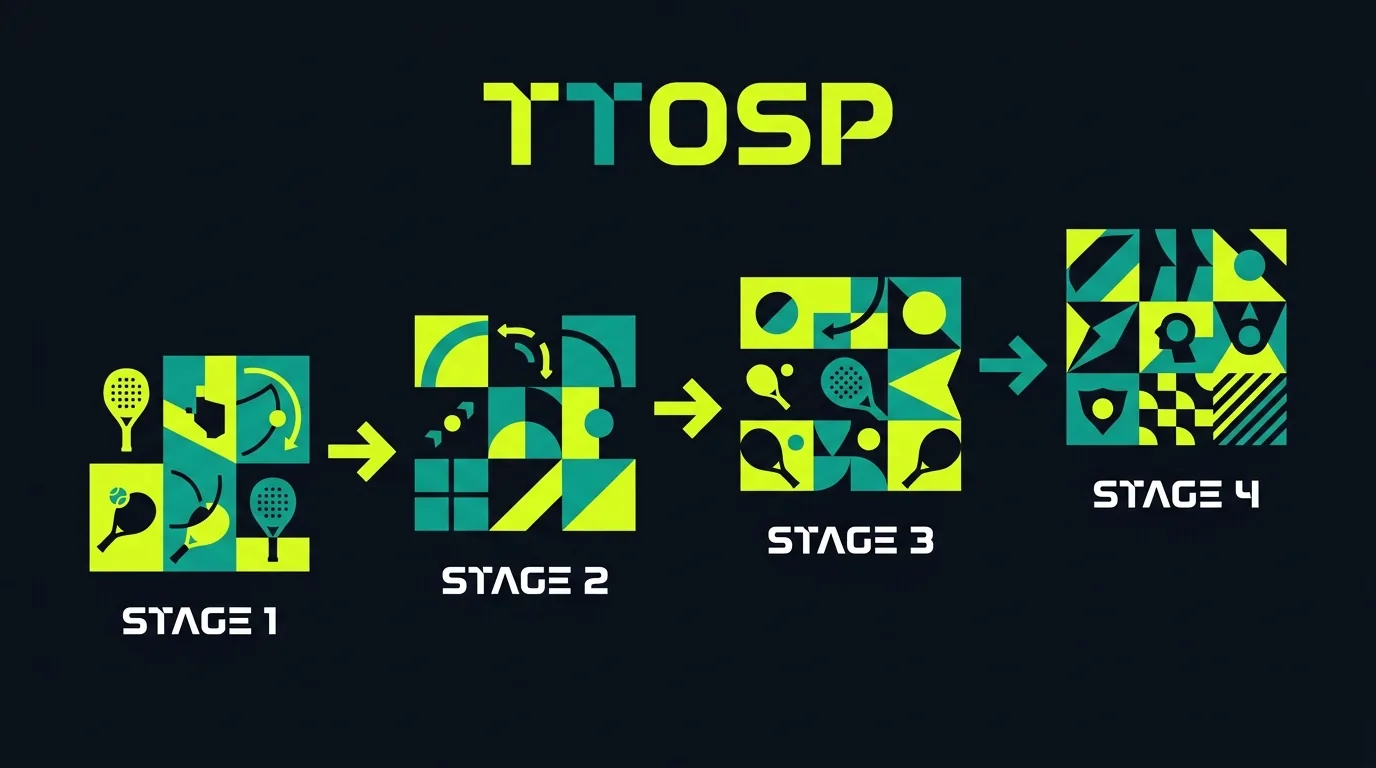
The TTOSP scales this principle across a player's full development. The research team built 57 items covering the technical-tactical objectives relevant at each stage — from foundational mechanics through to the compound, decision-heavy skills that technical players are working on. Twelve expert coaches reviewed each item, and the agreement between them was exceptionally strong, giving the tool a solid consensus foundation.

Why does this matter to you directly? Because it means the most effective coaching is deliberately staged, not improvised. When your coach prioritises one skill cluster over another, it should reflect a judgment about which objectives you are genuinely ready to absorb — not a random tour of the shot menu. Understanding that principle helps you commit more fully to each training block, even when you are drilling something that feels basic. If your training feels scattered or you are cycling between skills without a clear sense of accumulation, this is a good moment to ask your coach: which stage am I in right now, and what are the next two or three objectives on the horizon?

The paper does not publish the full list of objectives by stage — that content lives in the instrument itself, which is primarily designed for coaches and federations building curricula. But the fact that such a consensus framework now exists and has been formally validated is itself useful for any serious player. It means you can hold your training to a higher standard: is this session moving me forward on a defined, expert-agreed objective, or is it just keeping me busy?
By the numbers
12experts_participated
57initial_items_designed
3items_modified_aikev_below_0.70
0.97instrument_reliability_alpha
>0.79aikev_coefficient_for_rest_of_items

On court: try this

The tactical lob as a position reset

You and your partner are pinned at the back — your opponents hold the net and are pressing. Rather than trying to punch through them, commit to a high, deep globo (lob) aimed at the join between the back glass and the fence. The moment the ball leaves your racket, both of you step forward together. Your opponents have to retreat; you close the gap. The lob does not win the point — it resets the geometry. The shot and the advance are one action. If you wait to see where the ball lands before moving, you give back half the advantage you just earned.

Using the bandeja to hold the net

Your opponents lob over you. You have two options: retreat and defend, or play a bandeja (a controlled overhead angled into the side glass) that sends the ball into an awkward bounce position and lets you stay forward. Aim the bandeja so it angles into the side glass and kicks wide — not back to the centre where your opponents can re-attack comfortably. The tactical objective here is net retention: the shot is chosen because it keeps you in the attacking zone rather than pushing you back to the service line.

Committing to a point construction sequence

At the technical level, the clearest progress marker is knowing when a sequence is ready to finish versus when it still needs another construction ball. Before the point starts, agree a simple intention with your partner — for example, "we build toward the net and look to close from there." Then let that intention govern your shot selection: if the opening is not there yet, play the right construction ball rather than forcing an early finish. Reading the sequence, not just the individual ball, is what distinguishes technical play from reactive play.

Drills to practise

  1. Lob-and-advance (with a partner)
You and your partner start at the back; two players hold the net. Your partner feeds a short ball into mid-court. You play a globo toward the back glass, and both of you advance immediately to mid-court or beyond. Focus on: height (clear the net players' reach), depth (landing within a racket's length of the back glass), and your first two forward steps beginning before the ball lands. You are improving when the advance is automatic — your feet move without a conscious decision.
  1. Bandeja direction control (with a partner)
Your partner lobs overhead balls from mid-court. You alternate bandejas to the left side glass and the right side glass, placing a cone or tape strip as a target zone on each wall. Focus on: racket face angle at contact, not swing speed. A slower, more controlled swing with the correct face angle gives you far more directional precision than a hard hit. You are improving when you can hit the target zone consistently from varying lob heights and depths.
  1. Tactical intention pre-point (practice match)
Before each point in a practice game, declare your tactical intention out loud to your partner — "we attack the net," "we look for the wide angle to their backhand." Play the point trying to execute that intention. After the point, ask: did my shot choices serve that plan or drift from it? This drill builds the habit of connecting every decision to a purpose rather than reacting ball by ball.
  1. Technique-to-outcome mapping (solo or with coach)
Take one shot — your víbora (a spinning drive-volley typically played at the net, using topspin and sidespin to make the ball kick sharply off the glass) — and identify three distinct tactical uses: closing the point outright, pushing an opponent behind the glass, creating a short ball for your partner to finish. Practice each variant in blocks of 10 repetitions, keeping the preparation identical and changing only the target angle and pace. You are improving when your opponents cannot read which version is coming from the same preparation.

Common mistakes

    1. Drilling the shot without the tactical frame. Bandejas hit into a feeder bucket are useful for mechanics, but if you have no sense of why you are playing that shot in a point, the transfer to match play stays poor. Fix: attach a tactical objective to every drill, even a simple one.
    2. Treating the lob as a panic response. At the technical level, the globo is a deliberate positioning tool. A low or central lob signals uncertainty to your opponents and rarely buys you enough time to advance meaningfully. Fix: slow down your preparation, commit to height and depth, and start moving forward before the ball lands.
    3. Thinking in shots rather than sequences. Points are rarely won by isolated brilliance — they are constructed across several exchanges. Fixating on the last shot you missed keeps you stuck in a reactive loop. Fix: review points by asking "where did the sequence break?" rather than "which shot did I miss?"
    4. Jumping stages in training. Attempting advanced tactical combinations before foundational technique is automatic creates inconsistency under pressure — the execution breaks down exactly when the point matters most. Fix: confirm with your coach which objectives at your current stage are genuinely consolidated before you move to the next cluster.

Take it to your next match

Before you warm up, agree one tactical intention with your partner — something concrete: "we commit to the net after any good lob" or "we look for the wide bandeja before we try to close." Then track it point by point: are your shot choices in service of that intention, or are you drifting back into reaction mode? You will not execute it perfectly — that is fine. The research behind the TTOSP is built on exactly this connection between technique and tactical purpose, and the habit of playing with a conscious plan is, in itself, what structured padel development looks like from the inside.

◆ Coach edition — how to teach it

Padel has grown faster than its coaching science. Walk into most clubs today and you'll find coaches making decisions about what to teach based on intuition, habit, or what they themselves were taught — not a structured map of what a player needs at each stage of development. That's not a personal failure; it's a gap in the field. Until recently, no validated instrument existed to define the technical and tactical objectives a padel player should be pursuing at each developmental stage.

The TTOSP — Technical-Tactical Objectives by Stages for Padel — fills that gap. A Spanish research team designed a multi-item instrument covering the full range of technical-tactical objectives across player development stages, then put it through rigorous content validation with a panel of twelve padel experts. The result is a structured, field-tested tool that tells coaches and federations not just what to teach, but what to prioritise at each point in a player's journey.

Why does this matter for your sessions? Because the most damaging error in developmental coaching is misaligned sequencing — introducing a víbora before a player can reliably volley, or drilling tactical positioning with beginners who don't yet have stable groundstrokes. When a player struggles, the instinct is to correct technique. But the real problem is frequently that the objective itself is wrong for the stage. The TTOSP gives you a principled answer to the question: what should this player be working on right now?

The instrument spans both technical and tactical dimensions, which is important. Technique and tactics are not separate subjects in padel — they are coupled. The tactical objective drives the technical choice. If the goal is to earn the net, a deep lob aimed at passing the opposing pair demands precise placement, timing, and the footwork to follow it in. You can't separate "how to hit the lob" from "why the lob, and when." A tool that addresses both dimensions together reflects how the game actually works.

There is a subtlety worth naming. This study validates the instrument itself — it tells you the framework is sound and that expert coaches agree on what belongs in it. It doesn't yet tell you whether using TTOSP systematically improves player outcomes over time. That study is still to come. But having a validated starting map is the prerequisite for that research, and it's the prerequisite for coaching that is consistent, deliberate, and teachable across your entire staff.

For a sport that now counts more than 80 national federations, having a shared language for player development isn't a luxury — it's infrastructure.


By the numbers
12experts_participated
57initial_items_designed
3items_modified_aikev_below_0.70
0.97instrument_reliability_alpha
>0.79aikev_coefficient_for_rest_of_items

Coaching cues & teaching points

Apply these when assessing which objectives fit a player's current stage, and when communicating those objectives on court:

    1. "What's the objective of this point — placement, position, or pressure?" Trains players to name the tactical aim before they hit, building the decision habit from the start.
    2. "Technique serves the tactic." Use this when a player over-focuses on swing mechanics and loses sight of why the shot exists.
    3. "One objective per session." When introducing a stage-appropriate skill, narrow the focus ruthlessly. A session trying to fix the bandeja, the glass read, and serve placement simultaneously teaches none of them well.
    4. "Can you do this under pressure?" Stage progression is earned through reliability in match-representative conditions, not just in feeds.
    5. "Where are your feet before the ball arrives?" Positioning is the most consistently undertaught tactical objective at every stage.
A player isn't ready for the next stage when they can hit the shot — they're ready when they can choose the shot.

Drill & session plan

A four-step progression for introducing any stage-appropriate objective:

  1. objective-feed (isolated) — Coach hand-feeds to a fixed position. Player executes only the target skill — for example, a deep lob off the glass to earn the net — with no decision required. Success criterion: 7 of 10 technically clean repetitions.
  1. two-shot trigger (cooperative) — Coach or partner feeds a set-up ball; player executes the target shot, then both play out the point cooperatively. Decision is introduced but pressure remains low. Success criterion: player selects the correct shot in context on 7 of 10 repetitions.
  1. constrained game (pressured) — Play points with a rule: the target objective scores double if executed correctly. This raises the player's awareness of the opportunity without forcing the shot artificially. Success criterion: player attempts the objective on appropriate openings without prompting.
  1. open game (match-representative) — Remove all constraints. Observe whether the objective appears naturally. Success criterion: coach can identify at least three correct, unprompted executions across a 20-minute set.
One session is typically enough to move from step 1 to step 2. Steps 3 to 4 may require several sessions or weeks depending on the player's stage. Never end a session on isolated feeds alone — always progress to at least one decision-making step.

Common student errors & corrections

    1. Executing advanced shots too earlyCause: player has seen the víbora or bandeja del fondo from club peers and wants to replicate it. Fix: reference the developmental framework explicitly — explain that the shot belongs to a later stage, demonstrate the stage-appropriate alternative, and show why it produces better results now. Making the roadmap visible reduces frustration.
    1. Treating tactical objectives as optional extrasCause: sessions over-index on technique drills; decisions are never practised under pressure. Fix: build every drill toward a constrained game step. A session that ends only on feeds has not finished the job.
    1. Technical plateau with no tactical explanationCause: the player has adequate mechanics but no clear objective for when to use the shot. Fix: reframe the session goal — not "hit a better bandeja" but "use the bandeja to hold net position and force opponents wide." The tactical frame gives the technical refinement a purpose.
    1. Applying identical objectives across a mixed-level groupCause: the coach sets one goal for the whole group regardless of stage. Fix: use a staged framework to differentiate within the session. Run the same drill with skill-appropriate constraints for different players — beginners on the cooperative step while advanced players work the constrained game.

Adapting for levels

Beginner: Focus on foundational technical objectives — stable grip, basic groundstroke contact, and the serve introduction. The only tactical objective at this stage is positional awareness: net versus back. Do not introduce glass-play tactics or lob selection until contacts are consistent. All drills stay at steps 1 and 2 of the progression. Keep objectives singular and visible.

Intermediate: Technical objectives expand to shot selection off the glass, and the bandeja and chiquita enter as net-holding tools. Tactical objectives centre on the net/back transition — when to push forward, when to reset to the back wall. Step 3 (constrained game) becomes the primary training mode. Introduce the concept of the pair as the tactical unit: decisions are always made as a partnership, never in isolation.

Advanced: Technical objectives shift toward refinement under pressure — víbora placement, lob trajectory variation, serve-plus-first-volley patterns. Tactical objectives move into point construction: reading opponent tendencies, creating and closing windows, and managing the diagonal. Step 4 (open game) with structured post-play review is the dominant mode. The staged framework is most valuable here as a diagnostic — identify which specific objectives are lagging relative to overall playing level, and target those directly rather than repeating strengths.

Padel Profe© 2026 · Spiegamelo